

Phosphation – An indispensable preparation step in metal surface treatment
In the mechanical industry, industrial equipment manufacturing, automobiles, household electrical appliances or steel structures, the life of a product depends not only on the quality of the material but also greatly influenced by the surface treatment technology before coating. Among the current methods of protecting metals, phosphating is considered one of the most effective and popular pretreatment technologies.
This method helps to create a chemical metabolic film on the metal surface, increasing corrosion resistance, improving paint adhesion, and contributing to extending product life in harsh working environments.
What is Phosphate?
Phosphation is the process of treating metal surfaces with solutions containing phosphate salts to form an insoluble metal phosphate film on the surface of the material.
This film is formed through a chemical reaction between the base metal and the dihydrophosphate solution, creating phosphate crystals that adhere firmly to the surface. After being treated, the metal surface no longer has the full original metallic properties but becomes more stable, limiting oxidation and creating an ideal base for subsequent coatings.
This technology is widely applied to carbon steel, galvanized steel, iron and many other ferrous metals before powder coating or protective coating.
The important role of phosphate membrane
In actual production, the phosphate film not only plays an anti-rust role, but also brings many important benefits:
- Increase the adhesion of the coating.
- Limit paint peeling during use.
- Enhanced corrosion resistance under the coating.
- Creates a protective cushion between the metal and the environment.
- Support mechanical processing stages such as wire drawing, cold rolling.
- Increase the protective effect of anti-rust oils and surface sealants.
Thanks to its characteristic microporous structure, the phosphate layer allows paints or other coating materials to penetrate deeply and better mechanically bond with the metal substrate, thereby significantly improving the finish quality of the product.
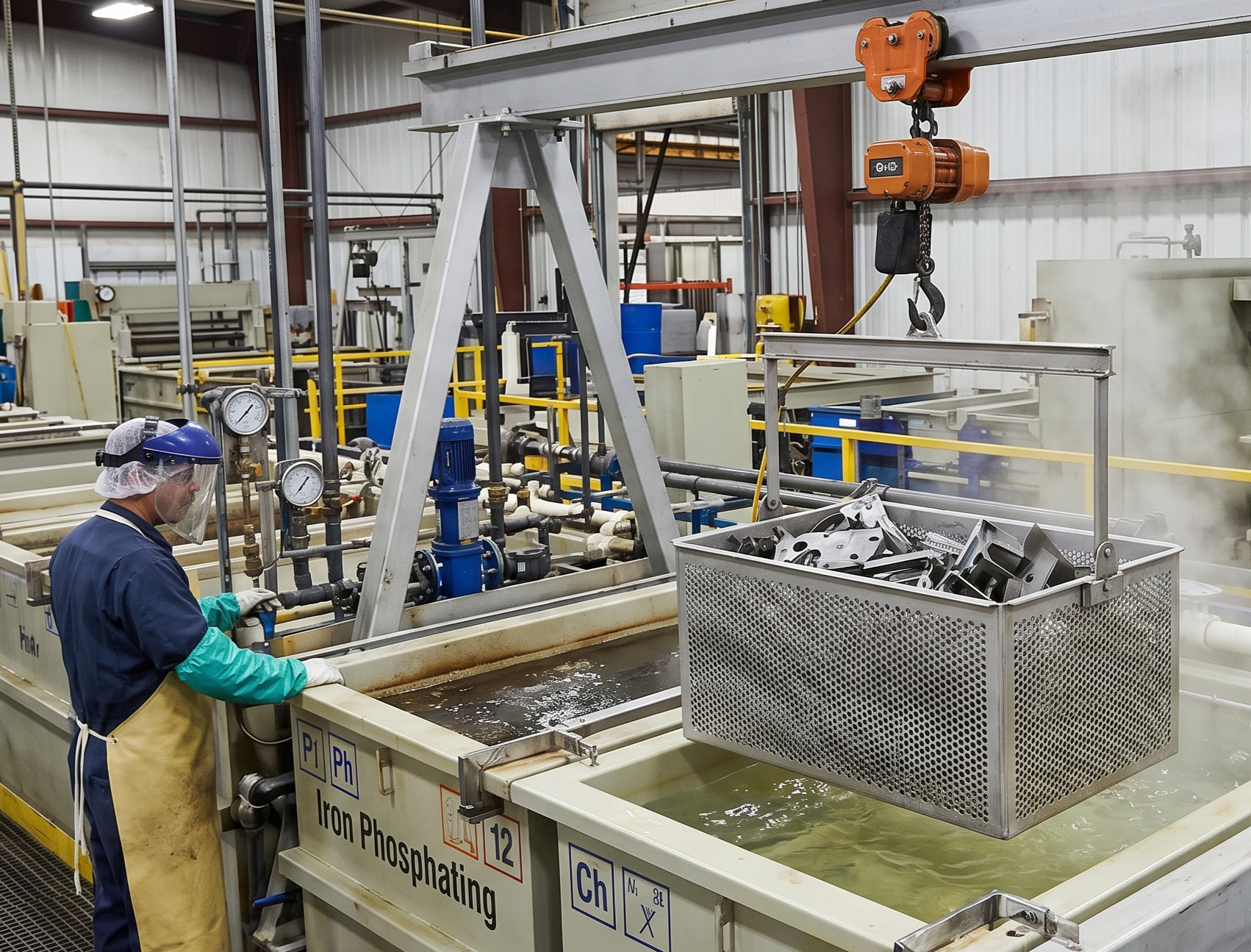
Among the current methods of protecting metals, phosphating is considered one of the most effective and popular pretreatment technologies.
Standard Phosphation Technology Process
In order to achieve a uniform and high-quality phosphate film, the surface treatment must be carried out according to a strict process consisting of several consecutive stages.
- Degreasing
During mechanical processing, metal surfaces are often exposed to cutting oils, grease and industrial dirt.
If not removed completely, these impurities will prevent the chemical from coming into contact with the metal, reducing the efficiency of the entire processing process.
Therefore, the degreasing stage plays a fundamental role, helping to clean the surface and facilitating further processing steps.
- Rust removal
After deoiling, the metal surface is further treated with an acid solution to remove the oxide and rust layers that exist on the surface.
This process helps the metal return to its activated state, allowing the phosphate layer to form more evenly and adhere more firmly.
After rust removal, the product needs to be thoroughly washed to completely remove the residual acid that remains on the surface.
- Surface shaping
Shaping is an important stage but often gets little attention.
The forming solution has the effect of creating crystalline centers on the metal surface, helping the phosphate layer to form smoother, more uniform and shortening the processing time.
Thanks to this step, the phosphate film achieves a higher quality and greatly improves the adhesion of the finish.
- Phosphation
This is the core stage of the entire process.
Phosphate solutions contain zinc compounds and catalysts that react with metal surfaces to form a protective phosphate film.
This film has a characteristic gray color that adheres firmly to the surface and provides an ideal base for powder coating or industrial coating processes.
To ensure coating quality, parameters such as total acidity, free acidity, acceleration, pH and processing time should be strictly controlled throughout operation.
- Passivation
After the formation of the phosphate layer, the product is further treated with a passivated solution.
The purpose of this stage is to create a thin layer of protection that limits oxidation, prevents yellowing of the surface and improves corrosion resistance without affecting the adhesion of the paint.
This is an important step to increase the stability of the phosphate layer during storage and transportation.
- Drying
The final stage is to completely dry the product by natural methods or heat drying.
After drying, the metal surface is ready for further stages such as powder coating, water-based painting, or other protective coating methods.
Common mistakes in phosphation
Although phosphation technology has been widely adopted, many businesses still encounter problems that affect coating quality.
Unclean oil removal
The grease left on the surface will cause the phosphate layer to form unevenly, even unable to adhere to the metal.
The cause often comes from insufficient chemical concentrations, too short treatment times, or inefficient washing systems.
Rust removal is not thorough
The remaining oxide layer or residual acid that has not been washed away can cause the surface to appear yellow stains, rust, or defects after phosphation.
Acid-contaminated forming tank
When the forming solution has a pH imbalance or is contaminated with acid from previous stages, the resulting phosphate layer may be yellowed and lose its uniformity.
Non-standard phosphate tank parameters
Operating indicators such as pH, total acidity (TA), free acidity (FA) or acceleration (SC) if exceeded the permissible limits will cause the phosphate film to be too thin, too thick or appear an unwanted porous structure.
Regular control of technological parameters is a decisive factor in the quality of the final product.
Phosphate application trends in modern industry
Along with the development of mechanical engineering and powder coating, phosphation technology is increasingly widely applied in the production of automotive components, motorcycles, electrical cabinets, steel structures, household appliances and many other industrial fields.
A well-controlled phosphation process not only improves coating quality, but also reduces maintenance costs, extends product life, and meets the increasingly stringent technical standards of the market.
DK Chemicals – a reliable partner in metal surface treatment chemical solutions
With many years of experience in the field of industrial chemicals, DK Chemicals is currently a provider of metal surface treatment solutions trusted by many mechanical manufacturing and processing enterprises.
DK Chemicals’ product portfolio includes:
- Metal-phosphating chemicals.
- Chemicals passivate the surface.
- Metal treatment and protection solutions.
- Specialized surface treatment solutions according to technical requirements.
Not only providing quality products, DK Chemicals also accompanies customers through technical consulting services, optimizing the operation process and supporting the handling of problems arising in production.
In the context that the industry is moving towards efficiency, quality and sustainable development, DK Chemicals continues to affirm its position as a reliable partner in the field of metal surface treatment chemicals in Vietnam.
For more information on solutions for metal phosphating processes, please refer to this link: https://dk-chemicals.vn/
See some of our other products here: https://dk-metalsurfacetreatment.com/san-pham-cong-ty-tnhh-hoa-chat-d-k/