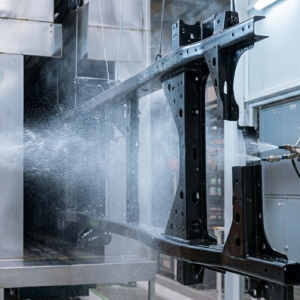


In the mechanical engineering, steel structure, automotive, household electrical and metal surface treatment industries, the quality of the surface before painting, plating or protective coating plays a decisive role in the durability and service life of the product. A surface that is not treated properly can reduce coating adhesion, accelerate corrosion, and increase maintenance costs.
At present, the two most commonly used methods are sandblasting and chemical surface treatment. Each technology has its own advantages and is suitable for each type of product, production scale as well as different technical requirements. So which solution should businesses choose?
The Role of Metal Surface Treatment
Before painting, plating, or protective coating is carried out, the metal surface should be thoroughly cleaned of grease, dirt, oxide layers, and other impurities.
An effective surface treatment process helps:
- Increase the adhesion of paints or coatings.
- Enhanced corrosion resistance.
- Improve product aesthetics.
- Increase service life.
- Reduce the risk of peeling or damage to the coating later.
In fact, sandblasting and surface treatment chemicals are the two most widely used solutions.
Chemical Metal Surface Treatment
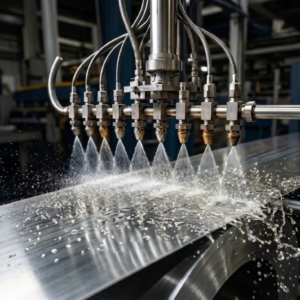
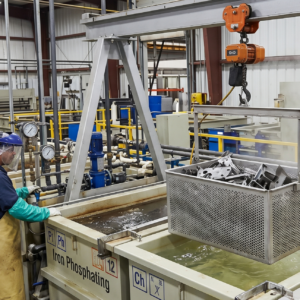
Chemical treatment is a method of using specialized solutions to clean, deoil, derust, activate, or create a protective film on a metal surface.
The process typically includes:
Step 1: Degreasing
Removes industrial oils, lubricants, and organic impurities from metal surfaces.
Step 2: Remove rust and oxide
Use specialized acid or chemical solutions to remove the rust and metal oxide layer.
Step 3: Surface activation
Facilitate the optimal state of the metal surface before painting, plating, or protective coating.
Step 4: Create a protection layer
Through technologies such as phosphation, chromation or passivation to increase the corrosion resistance and adhesion of the subsequent coating.
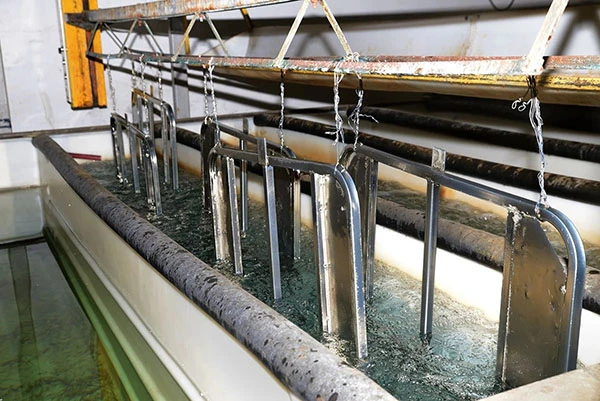
Chemical Metal Surface Treatment
Advantages of the chemical method
Thanks to its ability to act evenly over the entire surface, the chemical method offers many benefits:
- Increased corrosion resistance.
- Enhance the adhesion of paints and coatings.
- Improve the mechanical properties of the surface.
- Create aesthetic effects such as gloss or special colors.
- Support for subsequent bonding, welding, or machining stages.
In particular, this method is well suited for thin parts, complex shapes, or products that require high uniformity.
Limitations to be aware of
Besides the advantages, chemical treatment also requires:
- Standard wastewater treatment system.
- Choose the right chemical.
- Strict occupational safety control.
- Cost of investment in storage tanks and chemical lines.
- The factory area is relatively large.
Sandblasting – An Effective Mechanical Cleaning Solution
Sandblasting is a method that uses a high-speed abrasive flow to act on a metal surface to remove rust, old paint, and impurities.
The basic process includes:
Surface Preparation
Remove large obstructions and check product condition.
Grinding bead selection
Engineering sand, steel balls, aluminum oxide grains, or other specialized abrasive materials can be used.
Proceed with Spraying
Under high pressure, the abrasives hit the surface to clean and create the necessary roughness.
Testing and Finishing
After spraying, the surface is checked for cleanliness and roughness before moving on to the next stage.
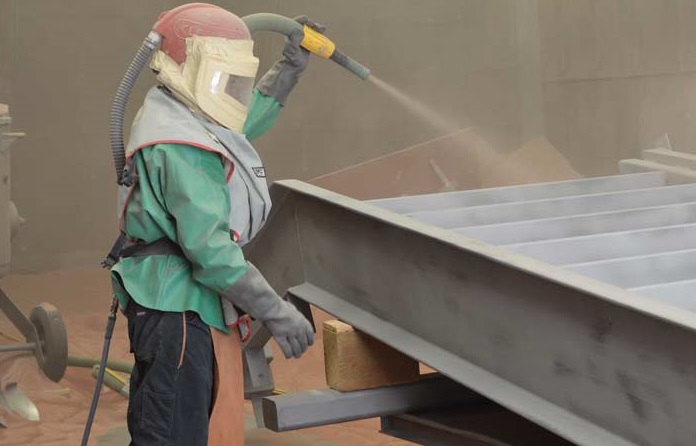
Sandblasting – An Effective Mechanical Cleaning Solution
Advantages of sandblasting technology
Sandblasting is highly appreciated for:
- Strong cleaning ability against rust and old coatings.
- Creates a uniform roughness that increases the adhesion of the paint.
- Eliminates internal stress on metal surfaces.
- Create a special aesthetic effect.
- No chemical waste is generated.
It is a popular choice for steel structures, industrial equipment, and heavily corroded products.
Limitations of sandblasting
Despite its high efficiency, this method still has some drawbacks:
- Dust and air pollution are generated.
- It can cause surface wear or deformation if the pressure is too great.
- Requires specialized equipment and high operating techniques.
- Not suitable for thin parts or soft materials.
- The cost of investing in a dust recovery and abrasive reuse system is quite large.
Sandblasting or Chemical: Which is the Better Option?
According to surface treatment experts, there is no one method that is optimal for every case.
Comparison Table of Sandblasting and Chemical Surface Treatment

Chemicals should be selected when:
- The product has a small thickness of less than 2 mm.
- The detail has intricate shapes.
- It is necessary to process evenly over a large area.
- Corrosion protection or chemical conversion layer is required.
Sandblasting should be chosen when:
- The surface is heavily rusted.
- It is necessary to create roughness before painting or anodizing.
- Large processing output.
- Requires fast and strong mechanical cleaning.
The optimal solution: combining both methods
In many modern lines, businesses often combine both chemicals and sandblasting to achieve maximum efficiency.
For example:
- Degreasing with chemicals.
- Sandblasting creates roughness and deep cleaning.
- Continue chemical treatment or passivation before painting and plating.
This approach helps to improve surface quality while optimizing coating life.
D.K Chemicals – a reliable partner in the field of metal surface treatment chemicals
In the context of increasing requirements for surface quality, D.K Chemicals is becoming a partner of choice for many mechanical engineering, plating and industrial production enterprises.
The company currently provides a variety of specialized solutions such as:
- Metal surface treatment chemicals.
- Passivation chemicals.
- Metal plating solution.
- Surface treatment solutions according to the unique technical requirements of each business.
Not only providing products, D.K Chemicals also supports technical consulting, process optimization and accompanies customers in improving surface quality, extending product life and reducing production costs.
Conclusion
Sandblasting and chemical treatment are both important technologies in the metal surface treatment industry. If sandblasting stands out for its powerful mechanical cleaning and effective roughness, chemical treatment provides corrosion resistance, increased adhesion and comprehensive surface protection. The selection of the appropriate method should be based on product characteristics, technical requirements, and production goals. In many cases, the combination of the two technologies is the key to helping businesses achieve optimal surface quality and improve competitiveness in the market.
Explore Some Surface Treatment Chemicals Here: https://dk-chemicals.vn/
Explore Some of Our Other Products Here: https://dk-metalsurfacetreatment.com/san-pham-cong-ty-tnhh-hoa-chat-d-k/